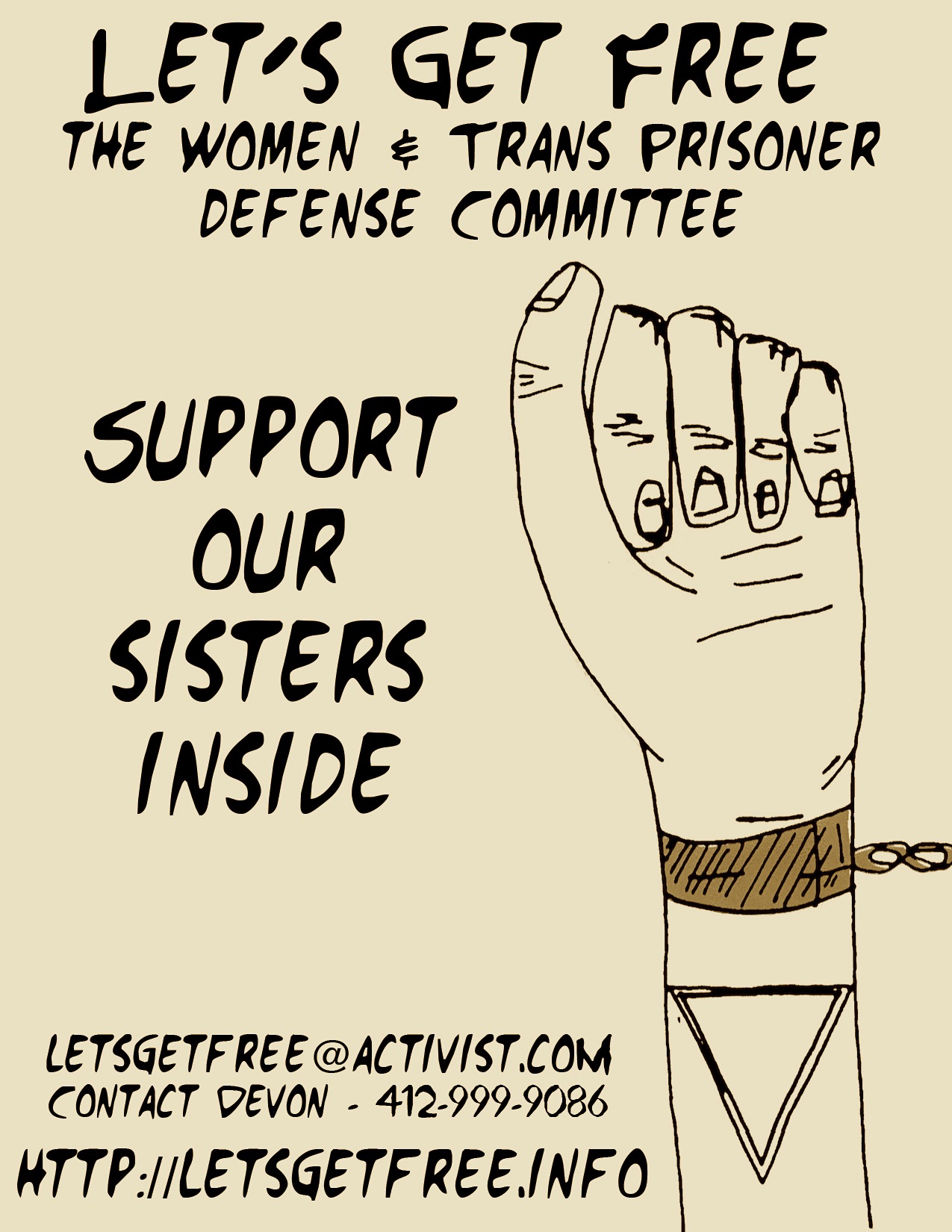
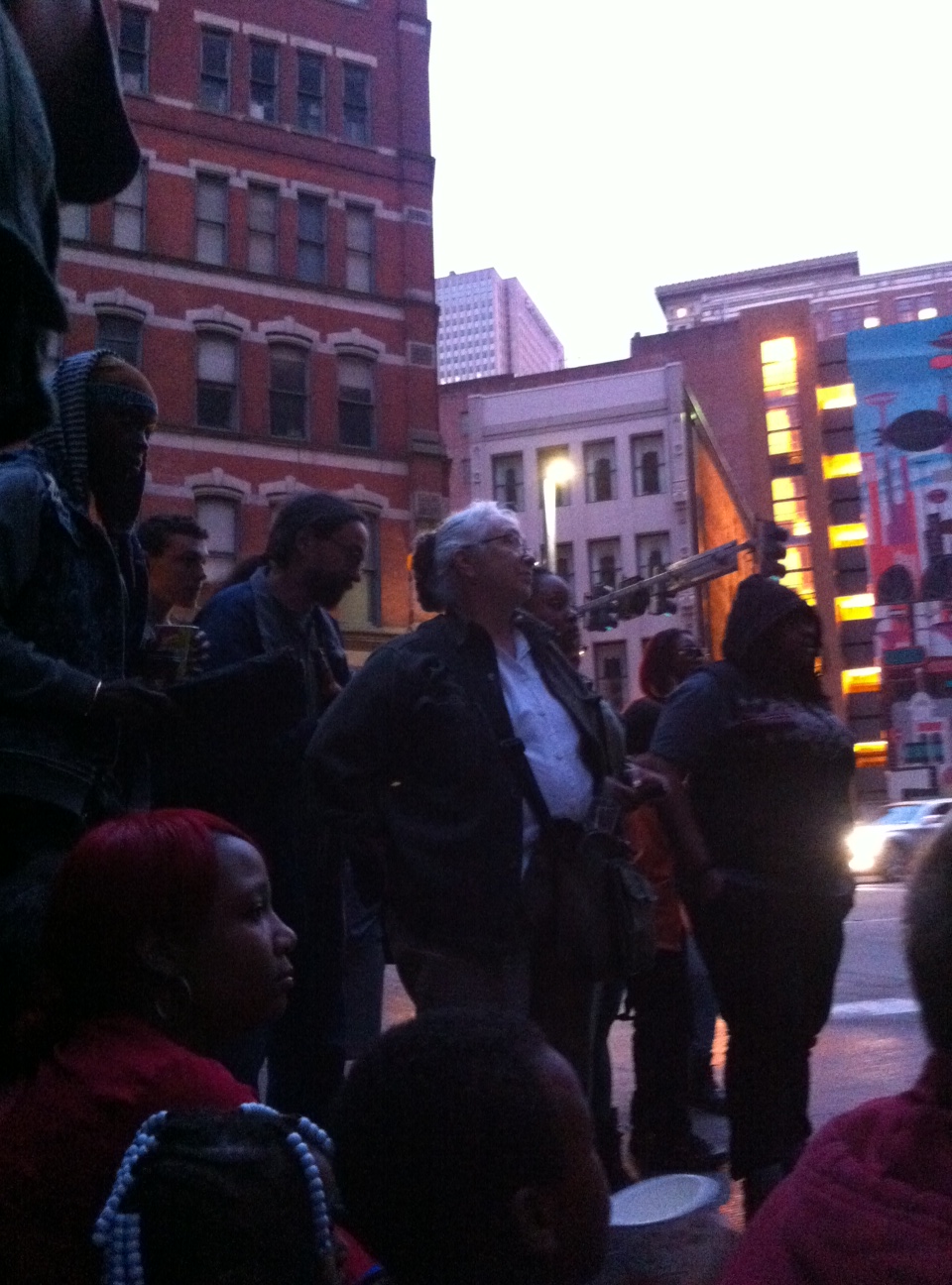
Members of Let’s Get Free will march with New Voices Pittsburgh – This Sunday! Meetings at 11am at Boulevard of the Allies and Grant. New Voices says – Are you ready to show your #BlackPride?!
Calling all Black #LGBTQ & allies to walk with @NewVoicesPgh in the Pride March, 6/15, Text 412.450.0290 to walk. #NVP#ReproJustice After the march we will engage and tell the story of our two proud sisters behind bars! Free Avis! Free Charmaine!
Today, the ACLU released Worse than Second Class: Solitary Confinement of Women in the United States. Recognizing that women in solitary are often ignored, the report examines the gendered impact of solitary and issues a series of recommendations. These recommendations assume that vulnerable populations will continue to be incarcerated and focus on ameliorating the harmful effects of solitary.
Further Harming Those with Mental Illness
Nearly seventy-five percent of incarcerated womenhave been diagnosed with mental illness, a rate much higher than that of their male counterparts. The report notes that a disturbing number of women with mental illness are held in solitary, sometimes for behavior that is beyond their control. Mental health experts recognize that long-term isolation is harmful for anyone, but particularly for those with pre-existing mental illness.
Recommendation: People (of all genders) with mental illness should never be held in isolation. Furthermore, women should be evaluated by competent and qualified practitioners to assess their medical and mental health conditions before being placed in solitary.
Re-Traumatizing Survivors of Past Abuse and Increasing Likelihood of Future Abuse
The majority of incarcerated women have reported past physical or sexual abuse. The lack of contact, human interaction and mental stimulation contribute to psychological deterioration for people who have experienced abuse. In addition, across the country, women in solitary areregularly supervised by male guards even when showering, changing clothes and using the toilet.
Solitary confinement also places a woman at greater risk for physical and/or sexual abuse by prison staff. Isolated from the general population, these abuses are easier for staff to hide.
Recommendation: Women’s histories of mental illness, trauma, abuse and sexual assault should be taken into account before placing them in solitary.
Punishing Women Who Report Abuse or Neglect
Prison staff utilize solitary to punish women for reporting abuse or neglect. Women who have complained about sexual abuse by prison staff are frequently placed in solitary confinement while their complaints are investigated. The threat of solitary often discourages other women from reporting abuse or neglect.
Women who report neglect have also been placed in isolation. The report highlights the case of Carol Lester, a 73-year-old grandmother who was placed in solitary confinement in a CCA-run prison for almost five weeks after complaining about inadequate medical care. She filed suit against the prison, arguing that placing her in solitary was retaliation for her complaints. She was released on probation/parole shortly after her story hit the media.
Recommendation: Solitary should never be used as a retaliatory measure. Qualified auditors should be specifically tasked with ensuring that people who report abuse are not placed in solitary confinement.
Punishing Children
Noting that the majority of incarcerated women are mothers, the report found that placing women in solitary negatively affects their children. Many women’s prisons are far from the areas in which mothers and children lived before incarceration. The distance, travel time and expense make visitation difficult and sometimes infrequent.
Placement in solitary makes these visits even more difficult. Visitation for people in solitary is often limited. Visits are often conducted through a glass partition or, as some states move towards video conferencing for visits, through a video monitor. Neither option allows a child the opportunity to hug her mother or hold hands. At other times, people in solitary are not allowed visits at all. Both undermine a mother’s efforts to remain connected to her children.
Recommendation: Contact visits with children should be allowed for all people. Family visitation should be encouraged.
Although the United Nations Rules for the Treatment of Women Prisoners and Non-Custodial Measures for Women Offenders (known as the Bangkok Rules) prohibit the placement of pregnant or nursing women in solitary confinement, jails and prisons across the U.S. continue to place pregnant and postpartum women in solitary.
Recommendation: Pregnant and nursing women should never be held in solitary confinement.
Isolating Trans Women
Solitary confinement is also utilized for trans women sent to male prisons. Justifying this placement as “protective custody” rather than punitive segregation, prisons place trans women in solitary units where they have little to no access to human contact, educational programs, exercise or recreation. Trans women in protective custody are subject to the same rules as people in punitive segregation—they are allowed out of their cell only one hour each day and allowed to shower only a few times a week. In addition, placing trans women in solitary increases their vulnerability to harassment and assault by prison staff.
Recommendation: Prison officials should not utilize isolation to protect vulnerable people. Those who may require extra protection should have access to the same programs, privileges and services as people in the general population.
The report also recommends:
That solitary be used only as a last resort and for as short a duration as possible;
That all jails and prisons have uniform written policies about solitary confinement practices and procedures. Policies should include written notification informing people about the reason for and duration of their placement; processes by which a person can earn privileges, such as access to commissary and visitation; and ways in which a person can earn release from solitary;
That all jails and prisons be required to regularly and publicly report details on people held in solitary, including the number, gender, duration, available alternatives and the reason why these alternatives were not utilized. There are currently no uniform state or federal data available about solitary confinement.
Although the ACLU recognizes that a high percentage of women are incarcerated for non-violent offenses, none of the recommendations focus on reducing the potential impact of solitary confinement by reducing the number of people sent to jails and prisons. All of the above recommendations assume that people with mental illnesses, histories of trauma and abuse, pregnancies or primary caregiving responsibilities will continue to be incarcerated. Their recommendations are important steps for ensuring the safety of people currently behind bars.
But more ambitious goals would call for building alternatives not just to solitary confinement but to the default policy of locking people up in the first place.
Calling all women and supporters to
(1) raise awareness of the increase in the rate of incarceration of women in the United States and the impact on our children and communities,
(2) Demand an end to voter disenfranchisement for people with felony convictions and
(3) Insure President Obama commutes the sentences of women and men in the federal system who have applied for commutation.
The number of women in prison, a third of whom are incarcerated for drug offenses, is increasing at nearly double the rate for men. This must change.
Let’s Get Free The Women and Trans Prisoner Defense Committee
is preparing for the hopeful and potential good news that Avis Lee will be granted a public hearing.
Avis was sentenced to life without parole under the Murder Felony Conviction Rule and has served 34 years in prison for her role as lookout for a robbery which ended in the unfortunate death of Mr. Robert Walker.
Avis applied for commutation in 2011 and could be assigned a public hearing any day now and we want to pack the courtroom. Will you come to Harrisburg with us to show your support? If you can’t attend can you help in other ways? In addition to attending the public hearing you can support by helping with logistics, blasting your social media and email contacts, or lending a car for others to use in carpool. All help is greatly appreciated! Fill out the form below or contact etta at 443-603-6964 – writealetta(at)gmail
And..If You Haven’t Already, Please Take 5 Minutes To Sign the Petition This small act DOES MAKE A DIFFERENCE. We want to walk into that hearing with 1,000 online signatures in addition to all the physical ones we have received.
Members of Let’s Get Free supported last Saturday’s benefit for the Abolitionist Law Center. It was a night of poetry, song, hip-hop, fellowship and prison abolition at the Bricolage Theatre in downtown Pittsburgh.
If you didn’t get a chance to go consider making a donation. The ALC is representing Charmaine and we support all their amazing efforts!The Abolitionist Law Center is a public interest law firm inspired by the struggle of political and politicized prisoners, and organized for the purpose of abolishing class and race based mass incarceration in the United States. – http://abolitionistlawcenter.org/
Performers included:
Joy KMT – self-taught&queer&black&femme&hood&poet&mother&lover&. She works from the possibility of the personal to be collectively transformational. Her work often blends the magical with the reality of living at the crossroads of multiplicities. Website: http://joykmt.com/ Joy read the following article which you can read on the website Black Girl Dangerous.
Blak Rapp Madusa – Born in Harrisburg, Pennsylvania Mel Carter also known as Blak Rapp Madusa emerges from the ghetto streets of Pennsylvania, taking the conscious music movement by storm. Through melodic lyricism this rapper/activist/poet paints a vivid picture of the black experience in America, the black nationalist movement, social and political justice ideologies interwoven with the spiritual inspiration of Islam. This artist is on a mission for change by spreading a positive message and a call to action for all oppressed people. Website: http://www.reverbnation.com/blakrappmadusa
Jacquea Mae – an amazing singer, actress,and spoken word artist that has graced the mic at several open mic events, theatrical productions, & has featured as a singer at many venues throughout the city of Pgh,PA. Ms. Mae continues to receive rave reviews for her powerful, often passionate, free, uninhibited, soulful, from the gut performances. Website: http://www.reverbnation.com/jacqueamae4
Terrell Johnson & Saundra Cole – After being framed for a murder he did not commit in 1994 in the Hazelwood murder of Pittsburgh, Terrell Johnson and his wife Saundra Cole set out on a mission to free him. In 2012 he was released from 17 years in prison after being acquitted at a retrial.
Donna Hill – President of Fight for Lifers West and mother of Charmaine Pfender, an Abolitionist Law Center client who has spent 29 years in prison for killing a man who was attempting to rape her. Self-defense is not a crime!
Jasmine Gonzales-Rose – Critical Race scholar, University of Pitt Law Professor, and Abolitionist Law Center board member
Russell the Third and etta cetera met for the first time!
Russell Shoatz III – son of political prisoner/prisoner of war, and Abolitionist Law Center client, Russell Maroon Shoatz
Bret Grote – Co-founder and executive director of the Abolitionist Law Center
One of the children pulled the fire alarm and we couldn’t figure out how to stop it even with the firefighters help. Russell and Black Rapp Madusa finished up the event in the ally alongside of the theatre. So fun! Thanks to Bee McBryde and all the HRC-FedUP crew for helping out with this great event!
Shadae Schmidt (aka Dae Dae) was a 32-year old African-American woman who died of a heart attack last Thursday, March 13th, 2014 at CIW prison (east of LA). We suspect her death is due to medical negligence because she had been asking for medical help for weeks. On February 3, 2014, Shadae had a stroke and within 2 weeks she was returned back to a cell in the solitary confinement unit (SHU) where she was still in active recovery. Upon her return, she was given medication that she repeatedly told medical staff was making her very sick. Her complaints fell on deaf ears and prison staff continued giving her the same medication which we believe led to her death on March 13th.
Shadae’s death is a terrible tragedy and one that happens far too often in California prisons because of severe medical neglect. We are asking for as many people as possible to call in and demand that the federal medical receiver’s office conduct an investigation into Shadae’s death immediately, before the prison tries to cover anything up.
Please pick up your phone now and call the Inmate Healthcare Inquiry Line: (916) 691-1404 to ask for an investigation into Shadae Schmidt’s untimely death (please reference her CDCR # W97014 and location at CIW). Just leave this request as a message after the prompts.
Thank you from the bottom of our hearts for your support!
Questions: contact Jayda at (562) 612-5816 or Colby (CCWP) at (415) 234-3837.
Yakiri behind bars. All photos by Hans-Máximo Musielik
Imagine that you are a 20-year-old woman walking at night to meet your friend or lover. Two men approach you on a motorcycle and say, “Get on, girl; we’ll give you a ride.” You tell them to fuck off, but they force you to get on their bike. Moments later, you have arrived at a hotel. With knives poking your back, they take you to their room. Once there, they hit you, cut you, and one of them rapes you. When he is about to cut you with his knife again, you take it away from him and slash his throat with it.
Hours later, you are the one facing charges for capital murder.
This is what happened on December 9, 2013, to Yakiri Rubí Rubio Aupart, a girl from Mexico City, who was imprisoned until recently at the Tepepan Female Center for Social Readaptation, located in the south of the city. She spent two months there on charges of “qualified murder.”
Yesterday, Yakiri Rubio was freed. On Monday, at the Court of Supreme Justice in Mexico City, her charges were changed from qualified murder to excess of legitimate defense. She was released on $30,000 bail, a sum 10 times higher than what her lawyers expected for her reduced charges.
But Yakiri still faces legal trouble—she will now be tried for “excess of legitimate defense.” If found guilty, she could face up to 10 years in prison.
Marina Beltrán, Yakiri’s mother, talks to her lawyer from home, minutes before heading to the Santa Marta Female Penitentiary for her daughter’s trial.
***
What exactly happened the night of December 9, 2013? It’s worth exploring in more detail, because Yakiri’s case has revealed a series of legal Catch-22s, irregularities, and abuses by the authorities in Mexico City that many victims of sexual violence suffer. Her story is relevant to any woman who is raped and decides to fight back.
When I started reading about the case it gave me the chills. Back then I was working in what is called the Obrera (Worker) neighborhood in Mexico City, and I used to walk the same streets as Yakiri on my way back home. I am a young woman who walks these roads at night alone. This could happen to me—or you.
According to Yakiri and her lawyer, at 7pm she left the Metro Doctores station and was walking on the Dr. Liceaga St. to meet her girlfriend, Rosa Gabriela Sánchez Vásquez, whom Yakiri had been dating for seven months. Two men approached her and tried to get her to ride their motorcycle. When she ignored them, one of them got off the bike and forced her to get on. Both the driver and the other man took her a few blocks away, to the Alcázar Hotel, located between the Justice Department of Mexico City and Mexico Arena.
Yakiri said that she couldn’t escape because she was snatched by force and scared because the receptionist at the hotel, even though he saw she’d been taken against her will, didn’t stop them. Then the rape and knife fight took place. According to Yakiri, she managed to get the knife of her rapist and slash his throat. He ran away, bleeding. According to the Ramírez Anaya family, Miguel Angel made it home and died next to his relatives, a few yards away from the entrance of the Prosecutor’s Office.
Yakiri left the hotel room half naked, looking for help. She said that no employee was willing to help her. She entered an ice cream store, where the employees gave her water and napkins to clean herself. Then she found two police officers and explained what happened to them. They took her to the Prosecutor’s Office, where she declared her rape. As she was waiting, Luis Omar arrived, accusing Yakiri of murdering his brother. They met in the same room. According to the Human Rights Commission of Mexico City, this procedure is completely illegal, because a victim of sexual violence “must always be in an exclusive waiting area in order to avoid any kind of contact with his or her possible aggressor.”
After 12 hours in the Prosecutor’s Office, Yakiri found out that she was going to be held in prison, facing charges for capital murder.
And what happened to the men? Miguel Angel Ramírez Anaya is dead (which is why Yakiri was in prison), and Luis Omar Ramírez Anaya is free. Yakiri has accused him of kidnapping and sexual violence, but there is no order of detention for him at this time. The General Prosecution Justice Department of Mexico City is supposedly investigating him, but meanwhile he was able to testify against Yakiri.
***
The family members of Yakiri are salsa musicians and activists in the neighborhood of Tepito. They have quit their jobs as musicians to devote their free time to freeing their daughter.
I met them in a meeting of the Citizen Committee for the Freedom of Yakiri, formed by her family after the rape. I went as a member of the art collective, who have supported the campaign to free Yakiri with graphic art. When I told the family that I was a journalist with a lot of interest in the case and that I am always hanging out in the neighborhood where she was attacked, they invited me to chat in their humble apartment in Tepito.
While they talked to me about the corruption in the Mexican justice system, Yakiri’s father, Jose Luis Rubio, showed me pictures of his adventures dancing and teaching salsa. After a few glasses of rum, they showed me cumbia steps, and we only stopped because the telephone rang. The voice of Yaki (as her family calls her) could be heard on the other side of the line. She calls every day to say hello to the family. That night we talked a bit, and I told her that I was going to visit her.
A week later I found myself in front of the Tepepan prison with 13 members of the Citizen Committee for the Freedom of Yakiri. That was the first time she was receiving a visit from someone who didn’t belong to her family, since Yakiri’s parents have not allowed press, for security reasons.
***
Where is the justice? In Yakiri Rubio’s case there are anomalies.
According to the Commission for Human Rights in Mexico City, the actions of the Prosecutor’s Office and the magistrate’s court “were focused on prosecuting a capital murder crime and ignoring a sexual violence crime.”
When Yakiri entered the Prosecutor’s Office, she didn’t get a test to confirm she had been raped. She was not even allowed to call her family. Lucia Lagunes Huerta, the director of CIMAC, a feminist news agency, told me that the written law and the implemented law are different things. “There is a certain logic in the world that women don’t matter and that violence against us is provoked by us,” said Huerta.
When I called the District Attorney’s office in Mexico City (PGJDF), they wouldn’t comment. But Rodolfo Ríos Garza, a member of the PGJDF, had said in a press conference: “We have statements in the previous investigation, where she enters the hotel willingly with someone and therefore there is no evidence of rape.”
The judge who sentenced her to prison, Santiago Avila Negron, was accused of corruption and sexual harassment in 2004.
In the first days after the rape, the Prosecutor’s Office focused on the possibility that Yakiri may have known her attackers, and even that one of them may have been her boyfriend. By chance she had some love letters from a friend whose first name was the same as the name of the deceased attacker. This was the basis for the Prosecutor’s Office to establish this false relationship between Yakiri and Miguel Angel Ramírez Anaya. A young man, Miguel Angel Camacho Campos, said he is the one that wrote the letters because he had a crush on Yakiri, and he volunteered to take a calligraphy exam to demonstrate he wrote the letters.
The Prosecutor’s Office has not accepted his offer. If she had known Miguel Angel, or even he was her boyfriend, the authorities would try to discard the possibility of rape. That is the way the Prosecutor’s Office thinks. Until this day they have not allowed Gaby, Yakiri’s girlfriend, to testify, which would help to clarify that the aggressor was not her lover, according to the Defense Committee. Nor has the testimony of Jose Edgar Vásquez Medina, uncle of the deceased, been taken into account. He said that his nephew was single and was living with his family.
In her purse Yakiri was carrying a box cutter and a knife for vegetables that, according to the Prosecutor’s Office, are the weapons she could have used to kill Miguel Angel. Yakiri says these are tools she uses at work to open boxes. The Alcázar Hotel is located in front of the Institute of Forensical Science of Mexico City, but the policeman that was in charge of investigating the scene of the crime didn’t follow the protocols, and they don’t have the required expert reports on the weapons, said Yakiri’s lawyer.
In Mexico, it wasn’t until the year 2000 that it was acknowledged that such a thing as spousal or partner rape existed. Perhaps that is why it doesn’t seem so surprising that the government and the press could discard the possibility of rape if Yakiri had known her attackers or even if she had entered the hotel of her own will.
The Commission for Human Rights of Mexico City released an amicus curiae together with Yakiri’s committee denouncing the irregularities in her case.
“The Prosecutor’s Office made a historical construction of the facts based on a partial and patriarchal vision that pushed for the minimization of Yakiri’s testimony as a victim of sexual violence,” the Commission wrote in its report. “This was used as the basis to treat [Yakiri] as a possible culprit, more than as a possible victim.”
Jose Luis Rubio, Yakiri’s father, talks on his cell phone the day of the trial, in front of the Santa Marta Female Prison.
***
In front of the jail there is a clothing-rental store for visitors. Just as in many prisons in the country, to access Yakiri’s cell—where she has been kept the past two months—visitors are not allowed to wear blue or any kind of black or beige. Those colors are assigned to guards and prisoners. Some of the girls that were hoping to enter the prison were wearing blue, and they had to rent red skirts in that store.
To enter the prison, we had to give our names to the committee one week in advance. A guard called us by name, and when we showed our IDs, they allowed us to pass to the second level of security, where they checked us for cell phones, cameras, tape recorders, and weapons. After this we were given forms in exchange for our IDs, and they marked us with fluorescent ink. Without this ink you cannot leave the prison.
They gave us a room for half an hour, and we formed a little circle to receive the prisoner. Before Yakiri arrived, we reorganized the place to make it nicer and placed the chairs in a ring. But when Yakiri arrived she sat at a table, since she didn’t notice we had reserved a place for her.
Yakiri came dressed in jeggings, jewel-studded sandals, and a big golden watch. There was a pause in anticipation. Yakiri seemed surprised to see so many visitors. I kept thinking, What would I do if this happened to me? I couldn’t think of myself being so calm after suffering such an attack, much less when facing a decade-long sentence in prison.
We asked her how she was doing, and she said everything was better since they moved her from the Santa Marta Acatitla prison. In Santa Marta she wasn’t able to eat or rest and just spent her time crying. She suffered a lot of violence when she was there. When we were exiting the jail, I asked her family what had happened in Santa Marta, and they said they supposed the family of the siblings had attacked her. They think Yakiri was “recommended,” meaning she was signaled to the mafia so that they would harass her and make her life extremely difficult in jail.
From the limited view I had in that prison, Tepepan seemed more or less quiet. We never saw other inmates. The room we were given had a purple tablecloth.
A group of activists look through a window while Yakiri is talking to the judge during her trial.
Yakiri told us how the ordeal has changed her so far. “Before my way of thinking was simple: There is only one life and you have to live it.” She used to spend her days working with her family, selling backpacks, and she didn’t think much about her future. “I am now fully aware of what may happen,” she said. “I know that being here calls for strength and courage.”
Yakiri said she overcame depression because she “had to be strong for her family, who are still fighting for me.” She smiled talking about the hundreds of letters of support that she got for Christmas. But the letters were a dubious joy—many of them were from girls who had gone through similar situations.
When I finally found the moment to speak, I asked if her opinion on justice had changed. She responded, “Before, I used to trust the police; I thought they were going to help me. But when I needed them, they didn’t help me. While I was at the prosecutor’s, they only lied to me. They said I was going to be able to leave, but I never was. I don’t think justice is useful anymore. If there were justice,” she said, “people who are outside would be inside.”
The festivities kicked off in a march and vigil against domestic violence and in memory of Ka’Sandra Wade, a local activist and friend who was killed last year by her ex-boyfriend. Her story stayed in the news because it exposed problems within police policies on responding to 911 calls for “unknown trouble.” Her family and advocates for women worked tirelessly to change those policies. Members of the ANEW Rising Women’s Collective gathered at the portico of the city council building to hold the vigil.
Participants and family members of Ka’Sandra Wade marched to the hotel where 1 Billion BEEN Rising was gathering and staged a die in to represent the over 100 women that have died due to domestic violence in Pennsylvania this year.
The One Billion BEEN Rising program started around noon. The youth really came out! There were so many enthusiastic young people. It was amazing!
The creative messaging was an awesome presence! While it felt so different having the event inside at the hotel because Market Square was a dangerous sheet of ice, all the banners and signs really transformed the place. In months leading to the event many volunteers worked at the Neighborhood Print Shop in Braddock to screen-print placards, patches and posters for the action. A local men’s group that organizes to unlearn and challenge sexism made some beautiful signs that were meant to be held by men. They said things like, “I love feelings. Violence against women is a mens’ issue. Gentle and proud. Men can change.” A series of posters were generated based on Andrea Smith’s platform –what should organizing around ending gender based violence look like?
More volunteers created vibrant colorful fabric banners, including slogans from movements past and present – from the civil rights movement, “We must be tender with each other so we can be dangerous together” and, “ The Revolution Starts at Home” which is also the title of a book about intimate partner violence in the activist community. “No one is disposable,” read another banner – referencing a recent video series by the Sylvia Rivera Law Project outlining strategies for every day prison abolition.
The rally kicked off with a drum call by Abafazi and a libation by La’Keisha Wolfe. During the libation, water is offered to the earth to honor the ancestors in the African tradition. In addition to speaking the names of our ancestors, there was space created to honor loved ones lost to domestic violence and those that survived.
Mythili Ramakrishna
Our first dancer was Dr.Mythili Ramakrishna who performed in India last year as part of the 1 Billion Rising there. The dance, Bharatanatyam is the strictly traditional and pure form of classical dance that has survived in the southern part of the Indian subcontinent in spite of centuries of social and political upheavals. This 2000 year-old art is still as fresh and fascinating as it must have been when it inspired the brilliant sculptors who have left records of Bharatanatyam in the magnificent temples of Tamil Nadu.The word Bharatanatyam is made up of three elements- ‘Bha’ or Bhaava (expressions), ‘Ra’ or Raaga (musical melody), and ‘Ta’ or Taala (rhythm).
On this day Dr.Mythili Ramakrishna performed the dance form within the realms of feminine power. The world mother, as the female divinity is known in India, represents the synthesis of the feminine energies of the universe, and illustrates how the female principle of God, Shakti, is inseparable from Shiva, the male principle of God. This piece symbolizes the cosmic cycles of creation and destruction, as well as the daily rhythm of birth and death. The dance is a pictorial allegory of the five principle manifestations of eternal energy — creation, destruction, preservation, salvation, and illusion, presented through fervor laden devotional poetry and rhythmic mnemonics, that create roiling waves of resounding beauty, energy, and a vision of a primordial energy of female power. The piece is called Shivoham and is composed by Adi Shankaracharya in the 8th century.
Bekezela Mguni
Ruth Martial, etta cetera, and Bekezela Mguni read aloud A letter to our sisters, ourselves, and the movement for radical social change and liberation. This letter was collectively written by One Billion BEEN Rising crew in response to important criticism to Eve Ensler and the 1BR organization by many feminist leaders of color all over the world. The letter expresses solidarity with the women and communities that have been harmed by the racism within the One Billion Rising movement. Ruth also spoke about how for the last 25 years, February 14th has been a day of action for missing and murdered indigenous women in the United States and Canada for decades. The purpose of this day – Annual Missing and Murdered Indigenous Women (MMIW) is not only to honor and remember the women but to demand justice and an official inquiry. These murders and missing persons cases are almost never even investigated. Some blockades have just gone up in Mohawk territory to protest the lack of response just in the last few days. The article Ruth quoted was by Lauren Chief Elk of the Save Wiyabi Project and you can find it here.
Black Rapp Madusa
Black Rapp Madusa performed a powerful poem she wrote while she was incarcerated. She spoke of the many women she met while incarcerated in Texas who had been locked up for self defense.
La ‘Tasha Mayes
La’Tasha Mayes of New Voices Pittsburgh; Women of Color for Reproductive Justice spoke about the case of Marissa Alexander. La’Tasha got the whole crowd wishing Marissa a Happy Valentine’s Day. In the beginning of March opposition to Marissa’s quest for justice escalated. The campaign website reads “Demonstrating a stunning abuse of power, Florida State Prosecutor, Angela Corey, announced that she aims to increase the prison sentence for Marissa Alexander from 20 to 60 years in the upcoming July 28th trial. In 2012, Alexander – an African American mother of three in Jacksonville, Florida — was sentenced to a mandatory minimum of 20 years for firing a warning shot upwards into a wall to defend her life from her abusive estranged husband. She caused no injuries. Alexander successfully appealed the unjust trial and was granted a new trial. In November 2013, after serving nearly three years in prison, she was released on bond to home detention until her new trial.”
“Yet as a consequence of winning the appeal to hopefully secure a more fair trial, Alexander now faces the alarming prospect that the original devastating sentence could be tripled in the new trial. In the upcoming trial, Corey says she intends to seek three 20 year sentences for Alexander to be served consecutively rather than concurrently, tripling the mandatory minimum to 60 years.”
“Free Marissa Now member and victim’s advocate, Sumayya Fire, stated, “Remember that this entire case boils down to a woman defending her life from her husband who attacked her, strangled her, threatened to kill her, whose beatings have sent her to the hospital and likely caused her to have premature labor. A husband who confirmed in a deposition that he beat her, that he was in a rage when he attacked her, and that he has beaten other women with whom he was involved. Remember that when Marissa Alexander fired her warning shot to save her own life, she caused no injuries. Now she’s facing the very real possibility of spending the rest of her life in prison for that act of self-defense. That should send a chill down the back of every person in this country who believes that women who are attacked have the right to defend themselves. Anyone who believes that domestic violence is unjust should be deeply shaken by Corey’s abusive prosecution of Marissa Alexander and should be advocating for Alexander’s freedom.”
Ruth, etta and Ngani calling our representatives about the nuisance ordinance while waiting for the DA’s office to come out!
Ngani Ndimbie spoke on behalf of the the ACLU. Several towns in PA have so-called “nuisance” ordinances which punish tenants who call the police with eviction even if they are calling to report a serious crime such as domestic violence. This is what happened to Lakisha Briggs, of Norristown, PA, who was threatened with eviction after she called the police for protection from an abusive ex-boyfriend. The ACLU of Pennsylvania is representing Lakisha Briggs and will fight the Norristown ordinance in court, but there is still more to be done. In response to the case, legislators drafted House Bill No. 1796. If passed, HB 1796 will prevent tenants and landlords from being penalized for requesting police assistance. The bill has already passed in the State House and has made its way to the State Senate. Contact your state Senator and urge him or her to support HB 1796.
Ginny Hildebrand from Stop Sexual Assault in the Military performed a chilling folk song that outlined four different scenarios highlighting forms of sexual violence with the chorus sounding – “if it could happen to you it could happen to me”. Joseph Hall, our amazing sound technician, read the man prayer and it was echoed by people who identify as men.
Interplay Dance troupe
Additional expressive and motivating performances were presented by the Improve Dance Troupe – Interplay, The Raging Grannies, and the poet Joy Yejide KMT, who posed the question, “How can you be silent when your silence is violent? Our silences are killing us.”
“30 years is too much time! Self Defense is not a crime! Free Charmaine Now!”
Members of Let’s Get Free – The Women and Trans Prisoner Defense Committee took the stage wearing soft ball style Free Charmaine t-shirts. Charmaine’s mother, Donna Hill, and Attorney Bret Grote, spoke about the tragic details of this case.
Charmaine Pfender was 18 years old when she took a life in self-defense and 19 years old when she was sentenced to life-without-parole for protecting herself against rape. She has served 30 years in prison. When the man she was on a date with pulled a knife and attempted to rape her, Charmaine struggled back, reached for a gun and fired a warning shot. When she tried to flee her attacker, he chased after her with a knife in hand, so she shot and killed him. Charmaine should never have been convicted of murder. She fought for her life against a knife-wielding man who was attempting to rape her. This is self-defense, not a crime. Donna asked everyone present to join her and Charmaine’s supporters in a march to the courthouse.
Devon, Bret and Donna on the way to the DA’s office
With the enthusiastic sounds of the Mayday Marching Band, all the beautiful banners and balloons, it really was a Valentine’s Day march – bursting with bright colors and messages of love. Let’s Get Free, The Women in Prison Defense Committee along with Charmaine’s mother, Donna Hill, Attorney Bret Grote, and a delegation of approximately 20 community leaders and concerned citizens braved the metal detectors and delivered chocolates and a letter wrapped in red ribbon to Allegheny County District Attorney Stephen Zappala calling upon him to re-open Charmaine’s case and to drop the charges against her. Meanwhile, the band and merry activists held down the court yard that sits in the middle of the building. Echoes of their songs could be heard through the halls, and curious lawyers, court attendees, and city workers lined the windows looking down at the colorful demonstration that circled the fountain.
Holding it down in the courtyard.
The delegation was told that Zappala was not in his office and was asked to wait for a long time to deliver the letter, in spite of the face that the campaign made a point to inform his office that they would be delivering the letters a week prior to the action. Finally, the spokesperson of the DA’s agreed to meet with Donna and Bret. While they listened, the office seemed to pass the buck and responded dismissively – “Let me refer you to an office in the Northside.” “Don’t waste your money sending postcards for your cause.” “Our office doesn’t investigate prosecutorial misconduct.” The delegation left the courthouse feeling undeterred and unsurprised by the response and walked into the loving arms of the 25 or so supporters who were STILL waiting and chanting in the court yard! Donna symbolically liberated a teddy bear from inside a balloon – “We WILL free my daughter.” We left the courtyard with the words of Assata Shakur on our lips, “It is our Duty to Fight for Our Freedom! It is our Duty to Win! We must love each other and support each other! We have nothing to lose but our chains!”
Zappala writes, “Ms. Pfender was convicted by a jury of several crimes including first degree murder in March of 1985. Although my jurisdiction in this case has long been relinquished, I have nonetheless assigned an assistant to review the transcripts of the testimony in the trial. That assistant has been directed to communicate with the attorney who has contacted the office on Ms. Pfender’s behalf.” While he is distancing himself from any obligation to do more than a review of the transcript, his prompt response and promise of review demonstrates a positive first step in the newly launched campaign to Free Charmaine!
Press conference: Friday February 14th Office of District Attorney Stephen Zappala, Room 303 Courthouse
2:00pm 436 Grant Street, Pittsburgh, PA 15219
Contact: Bret Grote 412-654-9070
DELEGATION WILL DELIVER LETTERS AND PETITIONS TO STEPHEN ZAPPALA,
PITTSBURGH DISTRICT ATTORNEY, REQUESTING DISMISSAL OF THE CHARGES AND
IMMEDIATE FREEDOM FOR CHARMAINE PFENDER.
This Valentine’s Day, in conjunction with One Billion Been Rising Pittsburgh and as part of a larger event
focused on ending gender based violence, Let’s Get Free, The Women in Prison Defense Committee
along with Charmaine’s mother, Donna Hill, Attorney Bret Grote, and a delegation of approximately 25
community leaders and concerned citizens. The delegation including members of the American Friends
Service Committee, New Voices Pittsburgh: Women of Color for Reproductive Justice, will be delivering
chocolates and a letter wrapped in red ribbon to Allegheny County District Attorney Stephen Zappala
calling upon him to re-open Charmaine’s case and to drop the charges against her.
Charmaine Pfender was 18 years old when she took a life in self-defense and 19 years old when she was sentenced to life-without-parole for protecting herself against rape. She has served 30 years in prison. When the man she was on a date with pulled a knife and attempted to rape her, Charmaine struggled back, reached for a gun and fired a warning shot. When she tried to flee her attacker, he chased after her with a knife in hand, so she shot and killed him. Charmaine should never have been convicted of murder. She fought for her life against a knife-wielding man who was attempting to rape her. This is self-defense, not a crime.
Charmaine Pfender is not a threat to society and would be a positive contribution to it if released. During her time at SCI Cambridge Springs, Charmaine has devoted herself to personal growth and service. She has received the highest prisoner rating available and has become a certified carpenter, completed courses in Violence Prevention, and gives back to the community by knitting 2-4 sweaters a month for children in need through the Lion’s Club. She maintains close and loving relationships with her family. In short, she is a normal, compassionate person who is doing her best to live a meaningful life despite the constraints that society has placed upon her. Just imagine who she could be if she were allowed to be free!
While the delegation delivers the letter, a dance party for incarcerated women with a marching band will take place simultaneously in the Courthouse Courtyard. Several hundred participants are expected.
30 YEARS IS TOO MUCH TIME SELF DEFENSE IS NOT A CRIME.
FREE CHARMAINE, NOW!
Let’s Get Free – The Women In Prison Defense Committee
Website – http://letsgetfree.info
Email – letsgetfree@activist.net
Twitter – @vivamarilynbuck
Wednesday Februray 12th at the Friends Meeting House, 4836 Ellsworth Ave, Oakland
7pm – Free Event
email to rsvp for childcare – writealetta(at)gmail.com
Women are the fastest growing U.S. prison population today. Eighty percent are mothers of school-age children. Jenifer McShane’s absorbing documentary gives human dimensions to these rarely reported statistics, taking us inside Bedford Hills Correctional Facility, a maximum security prison north of New York City.
MOTHERS OF BEDFORD follows five women of diverse backgrounds and incarcerated for different reasons in dual struggles to be engaged in their children’s lives and become their better selves. It shows how long-term sentences affect mother-child relationships and how Bedford’s innovative Children’s Center helps women maintain and improve bonds with children and adult relatives awaiting their return.
Filmmaker, Jenifer McShane, spent five years interviewing and visiting these women inside prison and the families awaiting their return. MOTHERS OF BEDFORD premiered at HOT DOCS 2011 and has screened at Lincoln Center and many other festivals andindependent theaters in the US.
Five Women, Five Stories: The people we follow in MOTHERS OF BEDFORD were sent to Bedford Hills Correctional Facility – all for different reasons. They have one thing in common: they are all mothers.
Melissa arrived at Bedford Hills pregnant. In her own words she “had lost everything but her own life” before landing in prison. We first meet Melissa and her daughter, Emma, in the cell they share when Emma is eight months old and revisit them until both are released from Bedford Hills when Emma is sixteen months old.
Tanika and son
Tanika When Tanika was arrested one of her sons was in first grade and the other in preschool. The boys are being raised by Tanika’s parents in a rough section of Schenectady. They are desperate to keep the boys out of trouble in a neighborhood that just keeps getting worse. Tanika Dickson is the only woman featured in MOTHERS OF BEDFORD who remains incarcerated at Bedford Hills Correctional Facility. She is currently preparing her application for parole.
Jacob and Mona
Mona High on angel dust at the time, Mona has no memory of riding as a passenger in a car involved in a hit and run. She awoke shackled to a hospital bed implicated in a crime she couldn’t recall. Nineteen at the time, she refused a plea deal because she felt five years seemed “like a lifetime away” from her two small children. She went to trial and was given a sentence of twenty to life. Mona was released in 2011, twenty-four years after being arrested. She attends many of the MOTHERS OF BEDFORD screenings to participate in the Q&A sessions with director, Jenifer McShane.
Rosa An employed mother of two when she was arrested, Rosa works in the baby nursery inside Bedford. She has a close relationship with her two sons, Jacob and Joey. Joey is entering adolescence and Rosa is learning to adapt to her son’s growing awareness of why she is in prison and the fact that he “must move on with his life”.
Rosa and son
Anneathia’s story has a generational component. We explore Anneathia’s relationship with her own mother Luecrezy, a recovering addict, as well as her ties to her own two daughters. During the film Anneathia and her mother mend broken trust and team up to get Anneathia’s two girls back in Luecrezy’s, care.