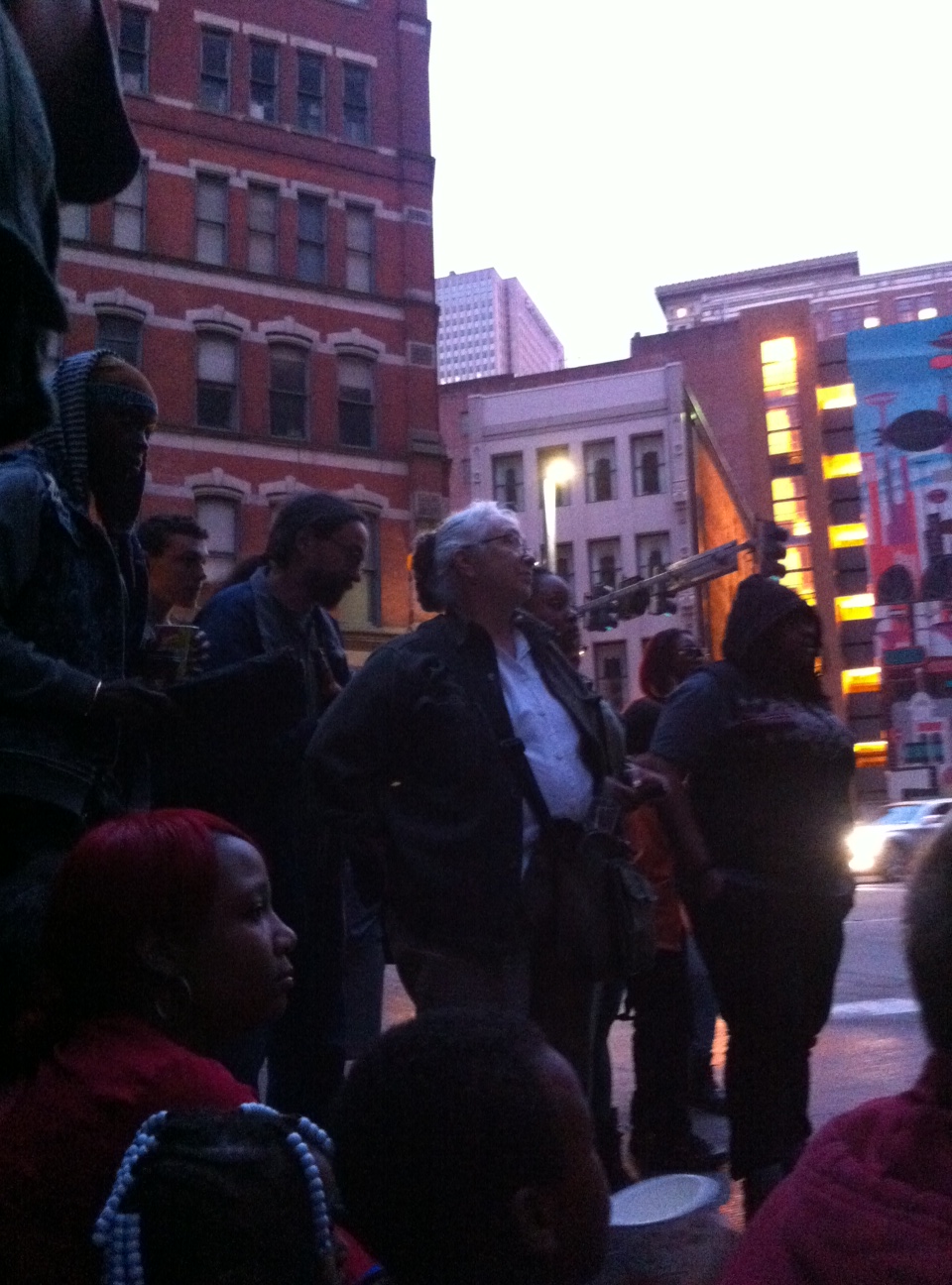
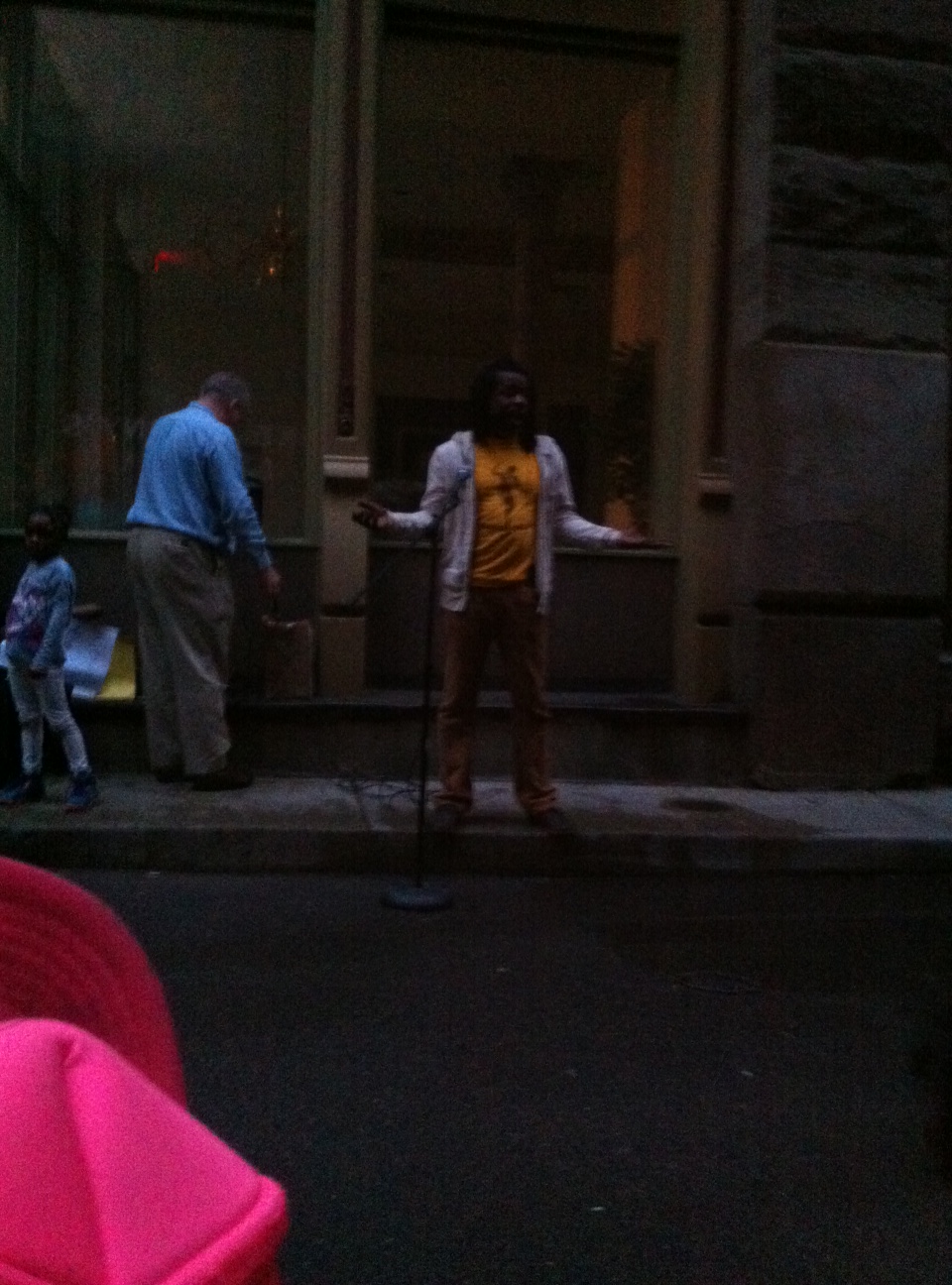
Members of Let’s Get Free supported last Saturday’s benefit for the Abolitionist Law Center. It was a night of poetry, song, hip-hop, fellowship and prison abolition at the Bricolage Theatre in downtown Pittsburgh.
If you didn’t get a chance to go consider making a donation. The ALC is representing Charmaine and we support all their amazing efforts!The Abolitionist Law Center is a public interest law firm inspired by the struggle of political and politicized prisoners, and organized for the purpose of abolishing class and race based mass incarceration in the United States. – http://abolitionistlawcenter.org/
Performers included:
Joy KMT – self-taught&queer&black&femme&hood&poet&mother&lover&. She works from the possibility of the personal to be collectively transformational. Her work often blends the magical with the reality of living at the crossroads of multiplicities. Website: http://joykmt.com/ Joy read the following article which you can read on the website Black Girl Dangerous.
Blak Rapp Madusa – Born in Harrisburg, Pennsylvania Mel Carter also known as Blak Rapp Madusa emerges from the ghetto streets of Pennsylvania, taking the conscious music movement by storm. Through melodic lyricism this rapper/activist/poet paints a vivid picture of the black experience in America, the black nationalist movement, social and political justice ideologies interwoven with the spiritual inspiration of Islam. This artist is on a mission for change by spreading a positive message and a call to action for all oppressed people. Website: http://www.reverbnation.com/blakrappmadusa
Jacquea Mae – an amazing singer, actress,and spoken word artist that has graced the mic at several open mic events, theatrical productions, & has featured as a singer at many venues throughout the city of Pgh,PA. Ms. Mae continues to receive rave reviews for her powerful, often passionate, free, uninhibited, soulful, from the gut performances. Website: http://www.reverbnation.com/jacqueamae4
Terrell Johnson & Saundra Cole – After being framed for a murder he did not commit in 1994 in the Hazelwood murder of Pittsburgh, Terrell Johnson and his wife Saundra Cole set out on a mission to free him. In 2012 he was released from 17 years in prison after being acquitted at a retrial.
Donna Hill – President of Fight for Lifers West and mother of Charmaine Pfender, an Abolitionist Law Center client who has spent 29 years in prison for killing a man who was attempting to rape her. Self-defense is not a crime!
Jasmine Gonzales-Rose – Critical Race scholar, University of Pitt Law Professor, and Abolitionist Law Center board member
Russell the Third and etta cetera met for the first time!
Russell Shoatz III – son of political prisoner/prisoner of war, and Abolitionist Law Center client, Russell Maroon Shoatz
Bret Grote – Co-founder and executive director of the Abolitionist Law Center
One of the children pulled the fire alarm and we couldn’t figure out how to stop it even with the firefighters help. Russell and Black Rapp Madusa finished up the event in the ally alongside of the theatre. So fun! Thanks to Bee McBryde and all the HRC-FedUP crew for helping out with this great event!
Shadae Schmidt (aka Dae Dae) was a 32-year old African-American woman who died of a heart attack last Thursday, March 13th, 2014 at CIW prison (east of LA). We suspect her death is due to medical negligence because she had been asking for medical help for weeks. On February 3, 2014, Shadae had a stroke and within 2 weeks she was returned back to a cell in the solitary confinement unit (SHU) where she was still in active recovery. Upon her return, she was given medication that she repeatedly told medical staff was making her very sick. Her complaints fell on deaf ears and prison staff continued giving her the same medication which we believe led to her death on March 13th.
Shadae’s death is a terrible tragedy and one that happens far too often in California prisons because of severe medical neglect. We are asking for as many people as possible to call in and demand that the federal medical receiver’s office conduct an investigation into Shadae’s death immediately, before the prison tries to cover anything up.
Please pick up your phone now and call the Inmate Healthcare Inquiry Line: (916) 691-1404 to ask for an investigation into Shadae Schmidt’s untimely death (please reference her CDCR # W97014 and location at CIW). Just leave this request as a message after the prompts.
Thank you from the bottom of our hearts for your support!
Questions: contact Jayda at (562) 612-5816 or Colby (CCWP) at (415) 234-3837.
Yakiri behind bars. All photos by Hans-Máximo Musielik
Imagine that you are a 20-year-old woman walking at night to meet your friend or lover. Two men approach you on a motorcycle and say, “Get on, girl; we’ll give you a ride.” You tell them to fuck off, but they force you to get on their bike. Moments later, you have arrived at a hotel. With knives poking your back, they take you to their room. Once there, they hit you, cut you, and one of them rapes you. When he is about to cut you with his knife again, you take it away from him and slash his throat with it.
Hours later, you are the one facing charges for capital murder.
This is what happened on December 9, 2013, to Yakiri Rubí Rubio Aupart, a girl from Mexico City, who was imprisoned until recently at the Tepepan Female Center for Social Readaptation, located in the south of the city. She spent two months there on charges of “qualified murder.”
Yesterday, Yakiri Rubio was freed. On Monday, at the Court of Supreme Justice in Mexico City, her charges were changed from qualified murder to excess of legitimate defense. She was released on $30,000 bail, a sum 10 times higher than what her lawyers expected for her reduced charges.
But Yakiri still faces legal trouble—she will now be tried for “excess of legitimate defense.” If found guilty, she could face up to 10 years in prison.
Marina Beltrán, Yakiri’s mother, talks to her lawyer from home, minutes before heading to the Santa Marta Female Penitentiary for her daughter’s trial.
***
What exactly happened the night of December 9, 2013? It’s worth exploring in more detail, because Yakiri’s case has revealed a series of legal Catch-22s, irregularities, and abuses by the authorities in Mexico City that many victims of sexual violence suffer. Her story is relevant to any woman who is raped and decides to fight back.
When I started reading about the case it gave me the chills. Back then I was working in what is called the Obrera (Worker) neighborhood in Mexico City, and I used to walk the same streets as Yakiri on my way back home. I am a young woman who walks these roads at night alone. This could happen to me—or you.
According to Yakiri and her lawyer, at 7pm she left the Metro Doctores station and was walking on the Dr. Liceaga St. to meet her girlfriend, Rosa Gabriela Sánchez Vásquez, whom Yakiri had been dating for seven months. Two men approached her and tried to get her to ride their motorcycle. When she ignored them, one of them got off the bike and forced her to get on. Both the driver and the other man took her a few blocks away, to the Alcázar Hotel, located between the Justice Department of Mexico City and Mexico Arena.
Yakiri said that she couldn’t escape because she was snatched by force and scared because the receptionist at the hotel, even though he saw she’d been taken against her will, didn’t stop them. Then the rape and knife fight took place. According to Yakiri, she managed to get the knife of her rapist and slash his throat. He ran away, bleeding. According to the Ramírez Anaya family, Miguel Angel made it home and died next to his relatives, a few yards away from the entrance of the Prosecutor’s Office.
Yakiri left the hotel room half naked, looking for help. She said that no employee was willing to help her. She entered an ice cream store, where the employees gave her water and napkins to clean herself. Then she found two police officers and explained what happened to them. They took her to the Prosecutor’s Office, where she declared her rape. As she was waiting, Luis Omar arrived, accusing Yakiri of murdering his brother. They met in the same room. According to the Human Rights Commission of Mexico City, this procedure is completely illegal, because a victim of sexual violence “must always be in an exclusive waiting area in order to avoid any kind of contact with his or her possible aggressor.”
After 12 hours in the Prosecutor’s Office, Yakiri found out that she was going to be held in prison, facing charges for capital murder.
And what happened to the men? Miguel Angel Ramírez Anaya is dead (which is why Yakiri was in prison), and Luis Omar Ramírez Anaya is free. Yakiri has accused him of kidnapping and sexual violence, but there is no order of detention for him at this time. The General Prosecution Justice Department of Mexico City is supposedly investigating him, but meanwhile he was able to testify against Yakiri.
***
The family members of Yakiri are salsa musicians and activists in the neighborhood of Tepito. They have quit their jobs as musicians to devote their free time to freeing their daughter.
I met them in a meeting of the Citizen Committee for the Freedom of Yakiri, formed by her family after the rape. I went as a member of the art collective, who have supported the campaign to free Yakiri with graphic art. When I told the family that I was a journalist with a lot of interest in the case and that I am always hanging out in the neighborhood where she was attacked, they invited me to chat in their humble apartment in Tepito.
While they talked to me about the corruption in the Mexican justice system, Yakiri’s father, Jose Luis Rubio, showed me pictures of his adventures dancing and teaching salsa. After a few glasses of rum, they showed me cumbia steps, and we only stopped because the telephone rang. The voice of Yaki (as her family calls her) could be heard on the other side of the line. She calls every day to say hello to the family. That night we talked a bit, and I told her that I was going to visit her.
A week later I found myself in front of the Tepepan prison with 13 members of the Citizen Committee for the Freedom of Yakiri. That was the first time she was receiving a visit from someone who didn’t belong to her family, since Yakiri’s parents have not allowed press, for security reasons.
***
Where is the justice? In Yakiri Rubio’s case there are anomalies.
According to the Commission for Human Rights in Mexico City, the actions of the Prosecutor’s Office and the magistrate’s court “were focused on prosecuting a capital murder crime and ignoring a sexual violence crime.”
When Yakiri entered the Prosecutor’s Office, she didn’t get a test to confirm she had been raped. She was not even allowed to call her family. Lucia Lagunes Huerta, the director of CIMAC, a feminist news agency, told me that the written law and the implemented law are different things. “There is a certain logic in the world that women don’t matter and that violence against us is provoked by us,” said Huerta.
When I called the District Attorney’s office in Mexico City (PGJDF), they wouldn’t comment. But Rodolfo Ríos Garza, a member of the PGJDF, had said in a press conference: “We have statements in the previous investigation, where she enters the hotel willingly with someone and therefore there is no evidence of rape.”
The judge who sentenced her to prison, Santiago Avila Negron, was accused of corruption and sexual harassment in 2004.
In the first days after the rape, the Prosecutor’s Office focused on the possibility that Yakiri may have known her attackers, and even that one of them may have been her boyfriend. By chance she had some love letters from a friend whose first name was the same as the name of the deceased attacker. This was the basis for the Prosecutor’s Office to establish this false relationship between Yakiri and Miguel Angel Ramírez Anaya. A young man, Miguel Angel Camacho Campos, said he is the one that wrote the letters because he had a crush on Yakiri, and he volunteered to take a calligraphy exam to demonstrate he wrote the letters.
The Prosecutor’s Office has not accepted his offer. If she had known Miguel Angel, or even he was her boyfriend, the authorities would try to discard the possibility of rape. That is the way the Prosecutor’s Office thinks. Until this day they have not allowed Gaby, Yakiri’s girlfriend, to testify, which would help to clarify that the aggressor was not her lover, according to the Defense Committee. Nor has the testimony of Jose Edgar Vásquez Medina, uncle of the deceased, been taken into account. He said that his nephew was single and was living with his family.
In her purse Yakiri was carrying a box cutter and a knife for vegetables that, according to the Prosecutor’s Office, are the weapons she could have used to kill Miguel Angel. Yakiri says these are tools she uses at work to open boxes. The Alcázar Hotel is located in front of the Institute of Forensical Science of Mexico City, but the policeman that was in charge of investigating the scene of the crime didn’t follow the protocols, and they don’t have the required expert reports on the weapons, said Yakiri’s lawyer.
In Mexico, it wasn’t until the year 2000 that it was acknowledged that such a thing as spousal or partner rape existed. Perhaps that is why it doesn’t seem so surprising that the government and the press could discard the possibility of rape if Yakiri had known her attackers or even if she had entered the hotel of her own will.
The Commission for Human Rights of Mexico City released an amicus curiae together with Yakiri’s committee denouncing the irregularities in her case.
“The Prosecutor’s Office made a historical construction of the facts based on a partial and patriarchal vision that pushed for the minimization of Yakiri’s testimony as a victim of sexual violence,” the Commission wrote in its report. “This was used as the basis to treat [Yakiri] as a possible culprit, more than as a possible victim.”
Jose Luis Rubio, Yakiri’s father, talks on his cell phone the day of the trial, in front of the Santa Marta Female Prison.
***
In front of the jail there is a clothing-rental store for visitors. Just as in many prisons in the country, to access Yakiri’s cell—where she has been kept the past two months—visitors are not allowed to wear blue or any kind of black or beige. Those colors are assigned to guards and prisoners. Some of the girls that were hoping to enter the prison were wearing blue, and they had to rent red skirts in that store.
To enter the prison, we had to give our names to the committee one week in advance. A guard called us by name, and when we showed our IDs, they allowed us to pass to the second level of security, where they checked us for cell phones, cameras, tape recorders, and weapons. After this we were given forms in exchange for our IDs, and they marked us with fluorescent ink. Without this ink you cannot leave the prison.
They gave us a room for half an hour, and we formed a little circle to receive the prisoner. Before Yakiri arrived, we reorganized the place to make it nicer and placed the chairs in a ring. But when Yakiri arrived she sat at a table, since she didn’t notice we had reserved a place for her.
Yakiri came dressed in jeggings, jewel-studded sandals, and a big golden watch. There was a pause in anticipation. Yakiri seemed surprised to see so many visitors. I kept thinking, What would I do if this happened to me? I couldn’t think of myself being so calm after suffering such an attack, much less when facing a decade-long sentence in prison.
We asked her how she was doing, and she said everything was better since they moved her from the Santa Marta Acatitla prison. In Santa Marta she wasn’t able to eat or rest and just spent her time crying. She suffered a lot of violence when she was there. When we were exiting the jail, I asked her family what had happened in Santa Marta, and they said they supposed the family of the siblings had attacked her. They think Yakiri was “recommended,” meaning she was signaled to the mafia so that they would harass her and make her life extremely difficult in jail.
From the limited view I had in that prison, Tepepan seemed more or less quiet. We never saw other inmates. The room we were given had a purple tablecloth.
A group of activists look through a window while Yakiri is talking to the judge during her trial.
Yakiri told us how the ordeal has changed her so far. “Before my way of thinking was simple: There is only one life and you have to live it.” She used to spend her days working with her family, selling backpacks, and she didn’t think much about her future. “I am now fully aware of what may happen,” she said. “I know that being here calls for strength and courage.”
Yakiri said she overcame depression because she “had to be strong for her family, who are still fighting for me.” She smiled talking about the hundreds of letters of support that she got for Christmas. But the letters were a dubious joy—many of them were from girls who had gone through similar situations.
When I finally found the moment to speak, I asked if her opinion on justice had changed. She responded, “Before, I used to trust the police; I thought they were going to help me. But when I needed them, they didn’t help me. While I was at the prosecutor’s, they only lied to me. They said I was going to be able to leave, but I never was. I don’t think justice is useful anymore. If there were justice,” she said, “people who are outside would be inside.”
Almost 15 years ago, Tanika Dickson was convicted of murder for defending herself from a racist assault which resulted in the death of David Gallup. We believe that self defense is not a crime and that she was wrongly convicted. She was sentenced to 15-life and has served 14 and a half years.
Tanika has applied for Limited Time Credit Allowance (LTCA) which allows an applicant to apply for 6 months off of the sentence after meeting certain criteria. It could takes several months to get an answer, but if approved the earliest she may see the parole board is in February.
We are asking people to send letters of support through Tanika’s lawyer by January 28th, in attempt that they will arrive before February. Below is background on the case.
Please write your support letters addressed to the NYS Parole Board in support of Tanika Dickson. Send them to her lawyer, Cheyry L. Kates-Benman Esq. is hoping to have received the letters by January 31 – So please get them in the mail by Tuesday January 28th! They are collecting all the letters to present them in a book.
Address the letter to: New York State Department of Corrections Department of Corrections and Community Supervision (NYSDCCS) Board of Parole
1220 Washington Ave Building 2 Albany, NY 12226
Send the letters to Tanika’s Lawyer –Cheryl L. Kates PO Box 734 Victor NY 14564
IT WILL ONLY TAKE 10 MINUTES OF YOUR TIME TO PERFORM THIS SMALL ACT OF SOLIDARITY THAT COULD HAVE A MEANINGFUL IMPACT – WE NEED YOUR SUPPORT
To Hear Tanika Dickson tell the story in her own words see the movie The Mothers of Bedford.
Background on Tanika’s Case –
Tanika Dickson pled guilty to the Murder of David Gallup. Accounts from witnesses indicated David Gallup, the brother of a Glenville police officer was in Casey’s Bar in Schenectady, NY, drinking for approximately 12 hours prior to the instant offense. He was severely intoxicated, and made some other patrons in the bar uncomfortable from acting strangely. Several witnesses knew this victim and indicated that on the day the crime was committed, he had been fired from his job at Wal-Mart for making racially offensive remarks. It was verified through police reports, the victim had a history of domestic violence against women and alcohol-related offenses.
The instant offense involved Ms. Dickson stabbing David Gallup in the neck while trying to exit the bar resulting in his death. Several disturbing things took place prior to the stabbing that led up to this event. A verbal altercation took place at the bar where David Gallup referred to Tanika as a “n*#%!r slut bitch.” At this time, the parties were separated by the bar’s security. David Gallup should have been escorted out of the bar due to the fact that he had been in the bar for at least 12 hours and was clearly in an intoxicated state. The bar continued to serve him alcohol.
Tanika tried to leave the bar peacefully. She recalls Mr. Gallup blocking her exit to the street. Out of fear, she reacted and stabbed Mr. Gallup. She was charged with Murder in the second degree. A plea was negotiated within 12 hours of the instant offense. Ms. Dickson was intoxicated at the time of the instant offense.
Because Tanika entered a plea waiving her right to appeal, she has limited legal remedies available to her. All post-conviction remedies pursued have failed.
During preparation of Tanika’s clemency packet, Tanika was evaluated by a psychologist who stated:
“From a record review and direct observation of Tanika Dickson, this examiner opines there is a mitigating factor of extreme emotional disturbance that contributed to the instant matter. Tanika was extremely intoxicated at the time of the crime after drinking that evening. The blood alcohol level probably present in Tanika would have diminished her control as well as diminished her capacity for rational thought. Secondly, Tanika felt threatened by the victim. His face was angry and he was saying threatening things. Tanika stated, “I was scared…I didn’t know what he was capable of doing to me.”
He continued:
“Tanika had a history of being raped as well as being physically abused. These strong memories also affected her emotional state in that she saw herself as a potential victim with no sense of being helped or anyone else as she approached the victim who suddenly blocked her exit from the bar.”
He further indicated:
“It is this examiner’s opinion that when Tanika refers to being blacked out that she is referring to an emotional black out caused by her extreme emotional disturbance and fear. This was not an alcoholic black out.”
The psychologist concluded:
“Tanika’s behavior was motivated by an understandable fear that she would be physically harmed and killed by the victim. He had threatened her verbally and non-verbally to a significant degree enough that the staff felt compelled to make him go to the other end of the bar.”
Take Action –Mail your letter before January 28th
Tips : Do not say anything like “it was a mistake”
Please write your support letters addressed to the NY Parole Board in support of Tanika Dickson. Send them to her lawyer, Cheyry L. Kates-Benman Esq. is hoping to have received the letters by January 31 – So please get them in the mail by Tuesday January 28th! They are collecting all the letters to present them in a book. Address the letter to: New York State Department of Corrections Department of Corrections and Community Supervision (NYSDCCS) Board of Parole
1220 Washington Ave Building 2 Albany, NY 12226
Send the letters to Tanika’s Lawyer –Cheryl L. Kates PO Box 734 Victor NY 14564
The turn of the year has brought us GREAT news for CeCe McDonald and Lynne Stewart.
After 19 months of incarceration CeCe is set to be released January McDonald is a young African American transgender woman who is charged with two counts of “second degree murder” after an incident that began when she was violently assaulted because of her gender and race. Read about her upcoming release in the Advocate article. Also, Keep in touch with Ce Ce via her facebook page and the main website of her support committee.
WELCOME HOME LYNNE!! Lynne Stewart was granted Compassionate Release and freed from prison for the New Year. Please read more about her case, unjust imprisonment and joyful return to her family and supporters at http://lynnestewart.org/
The first week of December, two members of Let’s Get Free visited the Board of Pardons and went to a hearing in the Supreme Courtroom at the Capitol Building in Harrisburg! We collected a lot of great information and got to experience what some of Avis’ hearing might be like.
There were 15 people on the roster for the board to rule on. They were all there for record clearing/ clemency, no commutations. Each person got 15 minutes to tell their story and then were cross examined by the board. Supporters could speak on their behalf as well, which seemed really effective when they were able to not only give a character reference but also specific anecdotes about the person. Then, any one present who opposed the pardon were given 15 minutes to speak. The psychologist spot on the board is vacant so there were only 4 members: Jim Cawley, Kathleen Kane, Louise Williams and Harris Gubernick. After all the cases the were heard, the court adjourned for 20 minutes (!) and then came back to vote on each case. If someone got 3 out of 4, the case was continued and 4 out of 4 votes the board recommended them to the governor to be pardoned. In one case it seemed like Jim Cawley changed his mind on the spot because everyone else had approved someone!
Most of the applicants had been young offenders with multiple convictions and attributed their bad decisions to the influence of peers. It seemed effective if people presented professionally, in dress and speech to illustrate that they had matured to become a different person than the young one that made bad decisions. The board asked a lot of questions about drugs and alcohol, and wanted to know specifics of programs people had completed. It didn’t seem like they could relate to individual motives of greed or carelessness. Some people were better at describing their personal accomplishments, without it being a long list that just becomes blubber. Our general conclusion was being as straightforward as possible, accountable to all details and not leaving anything out but not being too verbose is the preferred method.
pictured are Bekezela, Amanda and Michelle at the Women’s Walk for Peace. Amanda and Michelle are the members who went to the capital.
After the hearing, we walked to the Board of Pardons to hand deliver 100 postcards in support of Avis! We tried to find out more information about the next time commutation hearings would come up, but only got something as general as, sometime in the spring. We spent some time walking around Harrisburg, putting postcards in coffee shops and engaging a little with the general public about the case. Overall, we left feeling like we had learned a lot about the proceedings and the personalities of the Board members.
Join the Women in Prison Defense Committee, New Voices Pittsburgh, Alliance for Police Accountability and others as we walk for Marissa Alexander! We will also be walking for Avis and Charmaine and for justice for women in prison everywhere.
THE 6th ANNUAL WOMEN’S WALK FOR A PEACEFUL COMMUNITY will consist of a 2-mile walk which will start at the Pittsburgh Project (2801 North Charles Street | Pittsburgh, PA 15214) and wind its way through the neighborhood and end at West Park near the Aviary.